Concomitant EGFR mutation and EML4-ALK gene fusion in non-small cell lung cancer. Print this page 5 o: ]7 G& [+ F$ Y; v4 [
( d- v* U. w( F, h( Q' i3 q, b% x
Sub-category:) G) [+ v( ]- y" {5 S9 o
Molecular Targets 0 U2 S7 `" P0 h8 x3 {9 b* R$ T
- ~" l. K- J+ U
$ x/ b$ T6 X# d2 V4 CCategory:
0 }# k- _ }, d% kTumor Biology / n; O7 o; l0 j
m+ o- x9 h% {
! I+ y0 {& y1 x* o1 C1 h, GMeeting:
$ p6 B: K. \ D) Z o2011 ASCO Annual Meeting
% Y/ v1 e. R( i$ z! k
* S; h3 U) t) p) Y: @' _2 {' ]
/ V1 @+ Y: V2 O6 e6 r9 NSession Type and Session Title:
% B/ L9 h6 \: U8 f$ pPoster Discussion Session, Tumor Biology 9 A, P7 O( D7 B1 M# j( f, N
9 m E" u1 u* x* x6 {) ]: W8 S% Y6 T# n$ `4 n: S+ X
Abstract No:
3 j P0 m; O, i$ A: X$ w3 I10517
! ^ X% K$ y+ U4 x7 _4 q
( O+ d3 y6 C6 i' I
( @% D, h; `# X P VCitation:9 r: z5 ]* O& V D4 f; B- I
J Clin Oncol 29: 2011 (suppl; abstr 10517) ! s) h4 }, L" J; M1 L' @ v
& [. ]& H; m! j$ N9 l' I
% i" i' p% m8 _. o1 nAuthor(s):
! p: ]. I2 w/ T% k, x$ ?J. Yang, X. Zhang, J. Su, H. Chen, H. Tian, Y. Huang, C. Xu, Y. L. Wu; Guangdong Lung Cancer Institute, Guangdong General Hospital & Guangdong Academy of Medical Sciences, Guangzhou, China; Guangdong Lung Cancer Institute, Medical Research Center of Guangdong General Hospital, Guangzhou, China; Guangdong Lung Cancer Institute, Guangzhou, China; Guangdong Lung Cancer Institute, Guangdong General Hospital & Guangdong Academy of Medical Sciences, Guangzhou, China
% h4 r. c2 {/ r+ B- x d6 x% Q( o9 `$ @% W# d
0 ]8 w7 f; _, N8 Z
5 t; ]" Q) p$ g( sAbstracts that were granted an exception in accordance with ASCO's Conflict of Interest Policy are designated with a caret symbol (^) here and in the printed Proceedings.1 f) h( e2 ^) ?6 b: h
+ q; ^1 R, \0 ^2 V! e7 HAbstract Disclosures) W2 s+ z2 }% f* p9 V# `
# D6 G, H- H5 X/ ]+ @Abstract:
! ?! C% ]' i/ S$ `0 B% e% y* |) D5 U g; v% x2 ~
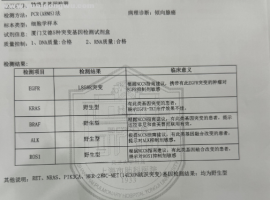
) E: M! m3 V! WBackground: The fusion of the anaplastic lymphoma kinase (ALK) with the echinoderm microtubule-associated protein-like 4 (EML4) and epidermal growth factor receptor (EGFR) mutations are considered mutually exclusive. Advanced non-small cell lung cancer (NSCLC) patients with EML4-ALK did not benefit from EGFR tyrosine kinase inhibitors (TKIs). Methods: Multiplex reverse transcriptase-polymerase chain reaction (RT-PCR) followed by sequencing was performed for EML4-ALK fusion status detection. EGFR and KRAS mutations were determined by direct DNA sequencing. Positive results of EML4-ALK fusion were also confirmed by RACE-coupled PCR sequencing. Results: From April 2010 to January 2011, 412 patients (398 with NSCLC; 14 with SCLC) were tested for mutation status of EGFR, KRAS and EML4-ALK respectively. Frequency of EML4-ALK fusion was 10.6% (42/398) in NSCLC patients. No patients with SCLC were found to have positive EML4-ALK fusion. Frequency of concomitant EGFR and EML4-ALK gene mutations was 1.0% (4/398) in NSCLC patients, and their variants of EML4-ALK gene mutations were Variant 1 (3 patients) and Variant 6 (1 patient); being never smokers, all of them were diagnosed with advanced (3 with stage †W and 1 with stage IIIB) adenocarcinoma harbouring wild type KRAS. Two female stage †W patients with double gene mutations (1 with L858R and Variant 1; 1 with exon19 deletion and Variant 6) received first-line gefitinib which is one kind of EGFR TKIs and achieved partial response. Conclusions: Though being rare events, NSCLC patients harbouring concomitant EGFR mutation and EML4-ALK gene fusion are sensitive to first-line EGFR TKIs. Whether they could also benefit from ALK inhibition after failure to EGFR TKIs warranted further investigation.' }, m- _3 ~0 z
8 u1 x" u4 S8 A. ^0 `9 p
& A" v) p2 ~3 ^, a1 P) B. n1 q" s |





 显身卡
显身卡